 |
Tasmanian Seafarers' Memorial
|
 |

Brigantine Creole (1863)
The plaque reads ... 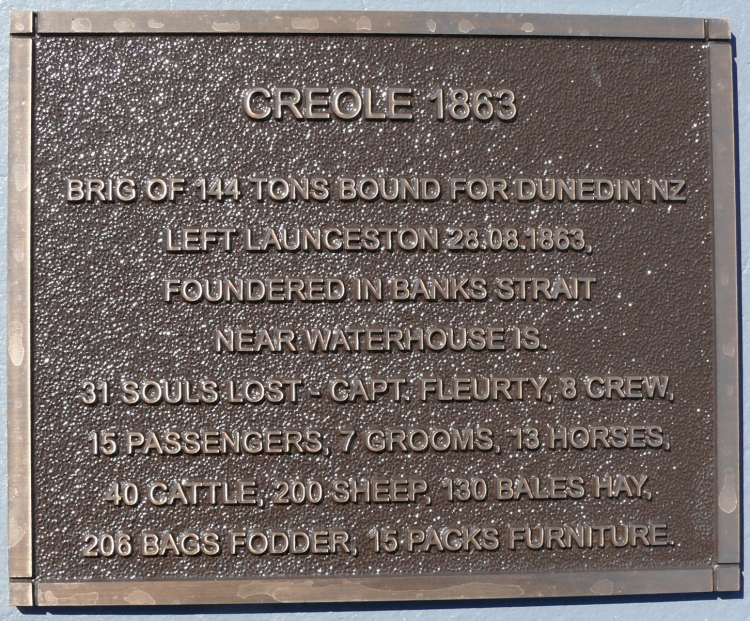
Creole 1863
Brig of 144 tons bound for Dunedin NZ
left Launceston 28.08.1863.
Foundered in Banks Strait
near Waterhouse Is.
31 souls lost - Capt. Fleurty, 8 crew
15 passengers, 7 grooms, 13 horses
40 cattle, 200 sheep, 130 bales hay
206 bags fodder, 15 packs furniture.
The Sydney Morning Herald of 9 October 1863 stated:
"LOSS OF THE BRIGANTINE
CREOLE.
"The brigantine Creole has been wrecked in Banks Straits,
and it is feared all hands are lost. We take the following particulars
relative to the melancholy occurrence from our Tasmanian files. The Launceston
Examiner of the 26th says :- General gloom pervaded the town yesterday, in consequence
of a report that the brigantine Creole, Captain Fleurty, which sailed
from this port on the 28th ultimo, had been wrecked in Banks' Straits, and that
every soul had perished."
The article concluded with:
"The Cornwall Chronicle of 26th says :-The Creole cleared the Tamar Heads for Dunedin on the forenoon of the 28th August. There was a strong north-westerly gale blowing at the time, and very bad weather on the 29th. It is supposed that even using the promptest exertions possible, it will occupy the police boat two days in going and returning ; yet it appears there is no speedier way available for ascertaining the facts. In the meantime the utmost anxiety prevails here respecting the fate of the Creole. She was commanded by Captain Fleurty, whose wife and family of five children reside in Cameron-street. She had on board the following passengers :-Mr. and Mrs. F.A.C. Townley and child, Mr James Dean (son of Mr W. M. Dean), Miss Bain, Mrs. Rattray and three children, Mrs Green, Mr. W. Weymouth, Mr. H. Clayton, Master Clayton and Samuel Clear, Francis Gibbs, John Lanton, William Coleby, J. Wilson, Thomas Green, Andrew Stephenson, steerage passengers, attending to stock. Her crew consisted, besides Captain Fleurty, of Norman, Clarke, John Cook, R. Mortimer, W. Devar and R. Thomson. "
Richard John Mortimer aged 19 pleaded guilty to the theft of stealing boots and shoes and was convicted in 1845. He was sentenced for transportation to Van Diemen's Land for 10 years. Mortimer was employed on the Creole as a groom attending to the heavy draught horses and mares.
The Launceston Examiner dated Saturday 26 September 1863 reported:
SUPPOSED
LOSS OF THE "CREOLE."
General gloom pervaded the town yesterday
In consequence of a report that the brigantine Creole, Capt. Fleurty, which sailed
from this port on 28th alt., had been wrecked in or near Banks Straits, and that every
soul had perished. The intelligence was brought by Mr. T. Williams, who has a sheep
station on this side of Ringarooma Bay, and who arrived in town on Thursday night.
From him we have obtained the following particulars. Mr. Williams left home on Tuesday,
riding along the beach for ten miles to the Trent, but he saw nothing to lead him to
suppose that a wreck had occurred. About 5 p.m. next day, he stopped at a small farm
four miles east of Piper's River, occupied by a person named Stephen Bartlett, where
he met William Brooks, who asked Mr. W. if he had seen anything of the wreck on his
beach. Upon Mr. Williams replying in the negative, Brooks went on to say that three
weeks from last Sunday (30th August) portions of a wreck were found on Waterhouse Beach
by himself and Mr. Wm. Barrett; together with the dead bodies of horses, cattle, and
sheep. There were also some letters, a boat and oars with "Creole" painted on them;
a chest with "Cook" painted on the lid; a pillow-case marked "Fleury" and a life-buoy
with "Creole" painted on it. There were also several trusses of hay. The wreck washed
on shore consisted of a portion of the deckhouse. On reaching the police station at
Piper's River Mr. Williams was informed by the constable that some days previously
he had heard from a man named Thomas Hardy, in the service of Mr. Headlam, that he
also had found some fragments of wreck in the deep bight a little to the west of the
River Trent, and about twelve miles from Waterhouse Beach. Both men who made these
reports are considered by Mr. Williams to be perfectly reliable: Brooks was in his
service for some time, but for several months past he has been engaged in the Straits,
and he was one of the purchasers of the General Jessop recently wrecked there; Hardy
has been in Mr. Headlam's employ for twenty years, so that there appears to be no reason
to doubt their statements. The only thing calculated to awaken suspicion as to the
truth of Brooks's story is the remarkable and culpable reticence displayed by himself
and Mr. Barrett. It does indeed seem incredible that any one pos sessing the common
feelings and instincts of humanity could have locked up in their own bosoms for so
long a period facts of such deep and mournful importance to numerous families. It seems
that Brooks was driven by stress of weather into the Little Forester River, where he
left his boat, and he had walked up to Bartlett's Farm.
The Police Magistrate here on receipt of the intelligence sent a telegram to Dr. Richardson, P.M. of George T'own, who forwarded a reply to the effect that the matter had been reported to him that morning, and he had sent instructions to the constable in the supposed locality of the wreck to keep a look out and to take all necessary measures.
From all the information at present available we regret to say that there appears to be too much ground for serious apprehension. There are so many circumstances confirmatory of the report that a wreck has occurred, and unfortunately all these circumstances point to the Creole. She was a fine American-built vessel of 130 tons, and from her great beam was a favorite for the conveyance of stock. The Creole cleared the Tamar Heads on Friday morning, 28th August, bound to Dunedln with a full cargo, the weather at the time being very boisterous, with wind at NW. Her passengers were- H Clayton, Esq. and son, Mr. and Mrs. F. A. C. Townley and child, Mr. Jas. Dean, Mr. W. Weymouth, Mrs. J. Raltray and three children, Miss Bain, and Mrs. Green. Captain Fleurty, Norman Clarke, mate. Crew- John Cook, R. Mortimer, T. Smith, W. Wilson, Thomas Joyce, W. Duvar, Robert Thompson, Samuel Clever, Fred. Gibbs, John Lamont, Wm. Colby, J. Wilson, Thomas Green, Andrew Stephenson, and J. Crisp. The following is the list of the cargo-200 fat sheep, 16 heifers, 25 head fat cattle, 12 cart horses, 160 bales hay, 100 bags bran, 600 ditto mangold wurtzel, 50 ditto carrots, 50 ditto oats, H. Clayton; 1 horse, James Dean; 15 pkgs furniture, Mrs. Rattray.
None of the cargo was insured, but we under- stand that the hull is covered in a Hobart Town office.
We may mention that the brigantine Mariposa, from Newcastle, and the schooner Oak, from Melbourne, both of which vessels have just arrived in port, report having sought for shelter on the 17th instant under Waterhouse Island and remaining there until Tuesday last, the 22nd instant, but during that time no traces whatever of a wreck were observed either on the Island or the beach opposite.
Since the above was written Brooks has arrived in town, having come up in his boat. He made himself known to Mr. Sherwin, who accompanied him to the office of Messrs. Glendow and Turner, agents for the Creole, and there made the following rather incoherent statement, which was taken down:
Young Cordell first saw 7 trusses hay on Waterhouse Island, and I saw 60 odd sheep and 2 or 8 ewes, with some half-bred Leicesters, a lot of broken carved chairs, and 2 broken cars, on Waterhouse Island; also a short-horned red cow, 2 horses (one black and one bay); boat, square stern, no name.
All the above on Waterhouse Island, N.W. Next day, on Mr. Williams's point, saw 13 trusses hay, some 2 or 3 quadrant boxes, a good many carrots, white and red, also white turnips, some cabbages, an American clock, some cabin doors with glass nobs, and some with glass doors, American locks, harness, cask painted white, cork fender with rope stool round top with four legs, pillow case and pillow marked "Fleurty," pillow marked "Gleadow," sheep-pens branded Creole, canvas hose about 10 feet long, A life buoy, painted white, and Creole. Music box, marked Davies. Box marked Cook. Other chests seen, but much broken. One water cask, 10 gallon cask. Portions of the wreck, marked white. About 8 or 9 hatches. One spar. Some baby linen, marked crimson and white. Cabin doors, all painted, with glass broken out. Crimean shirts. One earthenware nob. Could not get to Launceston before to-day. Barrett knew the same time as I did. Did not know that the Creole had left till I got to George Town. Found some letters (can't read), addressed Plymouth, as told me by Mr. Barrett. Mr. Barrett has them in possession since that time. Piece of plank found, with copper on. A sheet.
Brooks repeatedly declared that he saw no human bodies, and that he was prevented by the weather from making an earlier report. Mr. Turner has organised a party, consisting of Messrs. Clyne, T. Williams, and C.D.C. Propsting, who started this morning for Waterhouse to ascertain as far as possible the details of the disaster.
Plaque unveilled October 2024.